1. Metadata
IRI |
|
Preferred Label |
Roads Model |
Definition |
A Semantic Web data model of roads information. It caters specifically for Australian & New Zealand’s road labelling (naming) needs. |
Created |
2023-04-11 |
Modified |
2023-06-12 |
Issued |
0000-00-00 - not formally issued yet |
Creator |
|
Publisher |
|
History Note |
This model was made for Queensland Spatial Information, a unit of the Queensland Department of Resources, to assist with their future address and roads database design. It is a Component Model of their 'QSI Supermodel' which includes models for Address, Place Name and Cadastral information which are all designed to work together, however they may all be used independently too. |
Status |
Beta version |
Version |
|
Code Repository |
|
License |
|
Copyright |
© The State of Queensland (Department of Resources) 2020-2023 |
Machine-readable form (RDF) |
2. Preamble
2.1. Abstract
A Semantic Web data model of roads information. It caters specifically for Australian & New Zealand’s road naming needs.
|
Note
|
This model was made for Queensland Spatial Information, a unit of the Queensland Department of Resources, to assist with their future address and roads database design. It is a Component Model of their 'QSI Supermodel' which includes models for Address, Place Name and Cadastral information which are all designed to work together, however they may all be used independently too. |
2.2. Namespaces
This model is built on a small set of well-regarded Semantic Web models which use a variety of namespaces. Prefixes for these namespaces, used throughout this document, are listed below.
| Prefix | Namespace | Description |
|---|---|---|
|
This model |
|
|
Supporting vocabulary - Road Name Part Types |
|
|
Supporting vocabulary - Road Types |
|
|
Compound Name Model |
|
|
Dublin Core Terms |
|
|
Generic examples |
|
|
OGC GeoSPARQL model |
|
|
Lifecycle Model |
|
|
Web Ontology Language ontology |
|
|
RDF Schema ontology |
|
|
Sensor, Observation, Sample, and Actuator ontology |
|
|
Simple Knowledge Organization System (SKOS) ontology |
|
|
Time Ontology in OWL |
|
|
Vocabulary of Interlinked Data (VoID) ontology |
|
|
XML Schema Definitions ontology |
2.3. Conformance
This model conforms to the OntPub Profile which is a specification for ontology publication that mandates certain structural and metadata properties for the model as a whole and model elements. Metadata elements for the model as a whole - the ontology - are given in the Metadata section above.
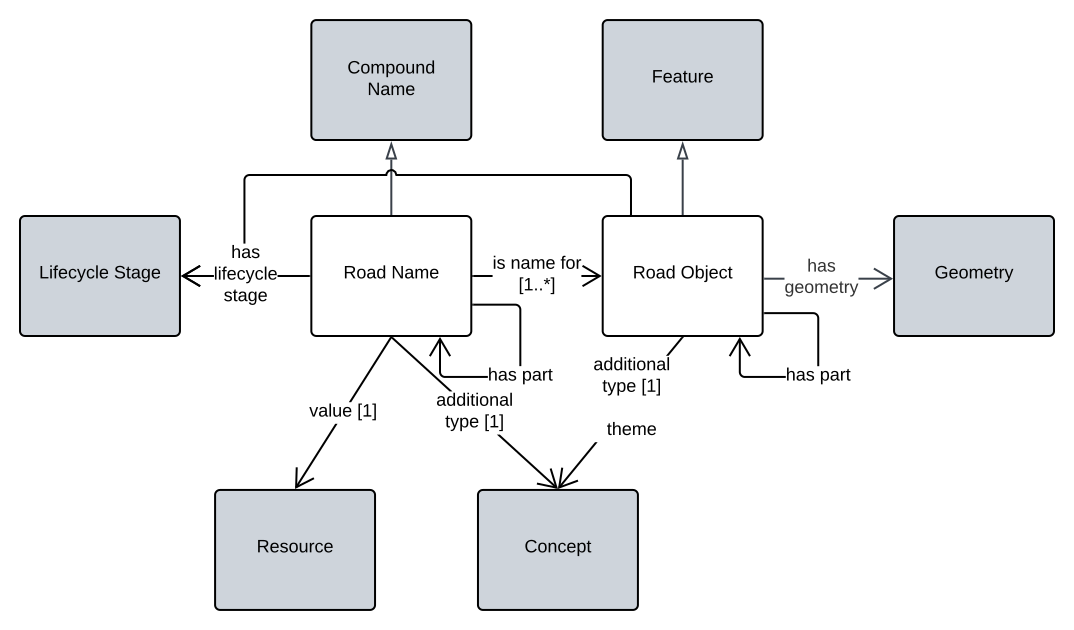
3. Introduction
This model facilitates applying Road Name objects, with potentially many subcomponents, to the geospatial representation of roads - Road Objects. This style of feature name / geospatial feature modelling is informed inherited from the Compound Naming Model that this model extends.
|
Note
|
This model does not attempt to assist with detail geospatial aspects of road modelling: it only provides an association between naming components and geospatial representations of the road established using other models and with categorisation of road objects. This model also does not link road objects to other, related, objects, such as Localities. Such linking should be represented with Feature / Feature topological relations, such as those within GeoSPARQL GEO. |
Data made according to this model, when stored in one of the RDF serialization formats such as TTL, is directly validatable according to this model through use of validators that are supplied, see Section Validation.
3.1. Sources of Requirements
This model was initially built to allow Queensland Government to manage roads naming information in a manner similar to how they manage Address & Geographic Name information: as a collection of Feature Names for Features which have Geometries. This introduces requirements to both facilitate complex naming and align with Address etc. modelling.
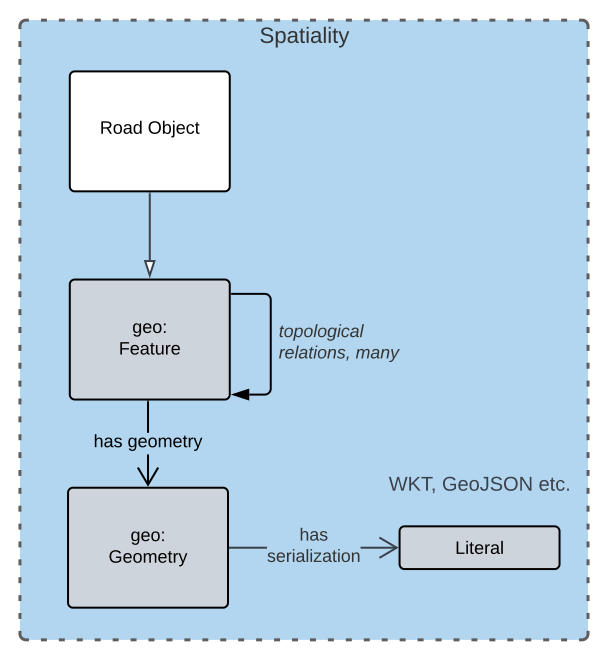
To ensure that this model implements that Feature Name / Feature / Geometry pattern, it is a profile of the Compound Naming Model which captures the pattern in generic form and is also profiled by Queensland Government’s Address & Geographic Names Models. Figure Roads Object spatial modelling overviews this. This introduces the requirement for all Roads Model information to conform to the Compound Names Model - the necessary requirement for profiling.
By profiling that model, this model also remains interoperable with detailed spatial object modelling, for example of the sort implemented in the Cadastre Model.
Detailed requirements for this model all stem from these top-level requirements. The individual requirements are listed in the Requirements section.
3.2. Major Modelling Principles
Major modelling principles present in this model are:
-
Feature / Feature Naming differentiation
-
Feature / Geometry differentiation
-
Profile Views
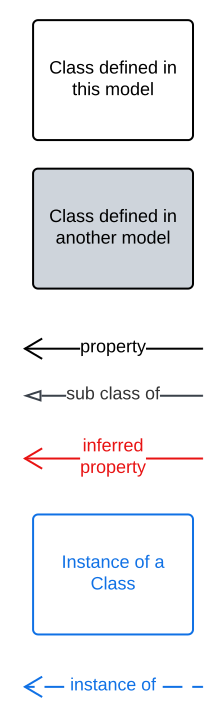
These principles are explained in the following sub-sections and the first two reference the following figure.
3.2.1. Feature / Feature Naming differentiation
This model details the elements of a road name but not details of the spatial objects that addresses are assigned to - the geospatial road objects. The general conceptual split of name/spatial object follows the Address/AddressableObject split in ISO19160-1 ISO19160-1. Addresses there are seen as a form of complex, multi-part, label - Feature Name - for a spatial Feature and Road Names here are considered a simple case of that.
This allows for the representation, and ultimately the management, of names - text, numbers, identifiers, references - separately to the management of spatial objects and their properties, such as the physical presentation of a Road.
This Feature / Feature Naming separation applies to Geographic Names, Roads and Administrative Areas as well as Addresses and this expression of Feature / Feature Naming separation for addressing is a formal profile of the more general Compound Naming Model CNM. There are other profiles for those other domains. The CNM, this model and the other CNM profiles are all pat of Queensland Spatial Information’s Supermodel which is an enterprise data model for multi-model data integration.
3.2.2. Feature / Geometry differentiation
(Geo)spatial objects referenced by this model’s naming objects (Road Names) are not geometries but conceptual spatial objects that have as an expression of their spatial projection one or more geometries. See Figure Roads Object spatial modelling. This conceptual object - Feature - and spatial expression - Geometry - split is based on fundamental spatial modelling in standards such as ISO19101-1 and their expression in the Semantic Web spatial standard GEO.
This Feature / Geometry distinction allows individual spatial objects to have multiple Geometries: different resolutions, in different coordinate systems and even sets of Geometries that have different roles or that show variation over time. This would allow Road Objects to have spatiallity represented with road centrelines, area polygons from cadastre etc., all at the same time, by linking those different spatial representations - the Geometries - to the single conceptual entity - the Feature.
3.3. Profile Views
Road Names have multiple roles: they indicate places with names (or Features with Names), they are things to be managed by data holders, and they have statuses, lifecycles and so on. Sometimes we are only interested in one of these aspects of a Road Name or one profile and not the total information held. We may also be interested only in a reduced set of properties of a Road Name even when others within that role are present, e.g. the current status, not all the statues an Address has ever had. Finally, different implementers of this model may want to implement different jurisdictional profiles of the model that, for example, mandate certain information be stored for Road Names, that may be meaningless outside that jurisdiction.
All of these sorts of profiles of Road Names are handled in a similar way in this model: they are declared Profiles of the model that may implement additional rules and/or requirements on data, however they must always conform to the main Roads Model itself.
3.4. Model resources
This document is this model’s "Specification" which is its authoritative, human-readable, definition document. This model also contains other resources with other roles:
| Resource | Role | Notes |
|---|---|---|
Schema |
The technical, machine-readable, version of this model |
|
Vocabulary |
The codelist vocabularies developed for this model and links to others defined elsewhere but used by this model |
|
Requirements Section |
Guidance |
The Requirements addressed by this model |
Validation Section & SHACL Validator |
Validation |
The machine-readable validator file used to validate data claiming conformance to this model |
Templating Section |
Guidance |
The template logic used for Basic and Short Form templates |
Examples Section & Extended example data files |
Example |
Examples of data conforming, and some not conforming, to this model |
Code Repository |
The online, version control, repository containing all the resources of this model |
4. Model
This model is composed of Web Ontology Language (OWL) OWL Classes and Properties. While some properties are restricted in their use to various classes, the Classes and Properties are actually defined individually and both are "first class model citizens", with global identity, that can be used in isolation and together. This is in contrast to Unified Modelling Language (UML) Class Diagrams which treat Properties as sub-parts of particular classes.
This model defines only two Classes and no Properties but reuses many Classes and Properties from other models. Where it does, basic details of, a reference to that Class or Properties' definition via rdfs:isDefinedBy, and a scope note about using it in this model are given.
4.1. Classes
4.1.1. Road Name
| Property | Value |
|---|---|
IRI |
|
Preferred Label |
Road Name |
Definition |
The Road Name class represents structured information that allows unambiguous determination of a Road Object for the purposes of identification and location |
Is Defined By |
This model |
Sub-class Of |
|
History Note |
Specialised from CNM's Compound Name class |
Expected Properties |
is name for, value, additionalType, hasPart, has lifecycle stage |
Example |
|
4.1.2. Road Object
| Property | Value |
|---|---|
IRI |
|
Preferred Label |
Road Object |
Definition |
A geospatial object that is unambiguously identified by a Road Name. Examples of types of RoadObjects are a sequences of cadastral parcels of type road. |
Is Defined By |
This model |
Sub-class Of |
|
History Note |
|
Scope note |
Judgement as to what makes for a permissible RoadObject rests with the implementer. This model’s technical requirements are only that the object is a legal |
Expected Properties |
|
Example |
|
4.1.3. Compound Name
| Property | Value |
|---|---|
IRI |
|
Preferred Label |
Compound Name |
Definition |
A Compound Name is a literal value, or objects that can be interpreted as literal values, that describe or name a Feature |
Is Defined By |
|
Scope Note |
The basis for the Road Name class. This class is also used for instances of Road Name parts |
4.1.4. Lifecycle Stage
| Property | Value |
|---|---|
IRI |
|
Preferred Label |
Compound Name |
Definition |
A Compound Name is a literal value, or objects that can be interpreted as literal values, that describe or name a Feature |
Is Defined By |
|
Scope Note |
Used to indicate the lifecycle stage of any Roads Model part. Different stage types may be necessary for different class instances such as Road Name and Road Object and may be sourced from different vocabularies |
4.1.5. Feature
| Property | Value |
|---|---|
IRI |
|
Preferred Label |
Feature |
Definition |
A discrete spatial phenomenon in a universe of discourse |
Is Defined By |
|
Scope Note |
Used as the basis for the Road Object class |
4.1.6. Geometry
| Property | Value |
|---|---|
IRI |
|
Preferred Label |
Geometry |
Definition |
A coherent set of direct positions in space. The positions are held within a Spatial Reference System (SRS). |
Is Defined By |
|
Scope Note |
Used to give spatial representation information for a Road Object |
4.1.7. Concept
| Property | Value |
|---|---|
IRI |
|
Preferred Label |
Concept |
Definition |
An idea or notion; a unit of thought |
Is Defined By |
|
Scope Note |
Used to indicate a value that should come from a vocabulary (modelled as a `skos:ConceptScheme) |
4.2. Properties
4.2.1. is name for
| Property | Value |
|---|---|
IRI |
|
Preferred Label |
is name for |
Definition |
Inverse of |
Is Defined By |
|
Domain |
|
Range |
|
Scope Note |
Used to link a name to a feature |
Example |
|
4.2.2. has lifecycle stage
| Property | Value |
|---|---|
IRI |
|
Preferred Label |
has lifecycle stage |
Definition |
Indicates a Resources' Lifecycle Stage |
Is Defined By |
|
Domain |
|
Range |
|
Scope Note |
Used to indicate an object’s lifecycle stage |
Example |
|
4.2.3. value
| Property | Value |
|---|---|
IRI |
|
Preferred Label |
value |
Definition |
Idiomatic property used for structured values |
Is Defined By |
|
Scope Note |
Used to indicate literal or object values for Compound Name objects |
4.2.4. additionalType
| Property | Value |
|---|---|
IRI |
|
Preferred Label |
additionalType |
Definition |
An additional type for the item, typically used for adding more specific types from external vocabularies |
Is Defined By |
|
Scope Note |
Used to indicate a subtype for Road Name and Road Object instances |
4.2.5. hasPart
| Property | Value |
|---|---|
IRI |
|
Preferred Label |
has part |
Definition |
Indicates a part of a whole |
Is Defined By |
|
Scope Note |
Used to indicate the parts of a Road Name or of a Road Object |
5. Supporting Vocabularies
This model depends on several vocabularies to give specific values for certain theming - general classification - and sub-typing properties.
The vocabularies are all independently-published and governed Knowledge Graph artifacts and do not record any relation to this model in their own data.
The vocabularies' details are given in the table below.
| Persistent IRI | Name | Description | Model property |
|---|---|---|---|
Road Names |
|||
Road Name Part Types |
This vocabulary describes values of name part types used in road naming |
|
|
Road Types |
This vocabulary describes road types. A road type is used as part of a road name and distinguishes the type of road. The road types that do not meet AS/NZS 4819:2011 exist to enable inclusion of roads named prior to the creation of AS/NZS 4819:2011. These types should not be used for any new road designations |
|
|
Road Suffixes |
This vocabulary describes values of suffixes used in road naming |
|
|
Road Objects |
|||
Road Classifications |
This vocabulary describes hierarchy classification types for roads |
|
|
Road Operational Statuses |
This vocabulary describes the operational status for roads |
|
|
Road Sub-Classes |
This vocabulary describes sub classifications of roads |
|
|
Road Surfaces |
This vocabulary describes surfaces of roads |
|
|
6. Requirements
Here are the itemised Requirements referenced in the Sources of Requirements subsection of the Introduction and note for them on how this model satisfies them.
6.1. Requirements List
| ID | Name | Description |
|---|---|---|
Req01 |
MUST align with Address modelling |
Profiles the Compound Naming Model CNM and the Lifecycle Model LM which the QSI Address Model also profiles |
Req02 |
MUST implement the Feature Name / Feature pattern |
Implements Road Name & Road Object to specialise the pattern for roads |
Req03 |
MUST be interoperable with detailed spatial object modelling, for example of the sort implemented in the Cadastre Model |
Implements Road Object as a GeoSPARQL Feature to which any GeoSPARQL spatial modelling can be applied |
7. Validation
This section will be completed when Business Rules for Road Names are determined - etc. June, 2023
8. Templating
To present - on screen or in print form - the consolidated name for a Road Name, the parts need to be assembled in a particular order and perhaps processes to make contractions etc. The logic for this is not contained in the Classes or Properties of the model but in this Templating section.
Users of this model are free to implement additional templates and template logic to suit their needs.
8.1. Basic Template
This template assembles the parts of a Road Name’s in the most basic manner, and is expected to be the most commonly used template.
The template, in EBNF form ISO-IEC-14977, is:
space = " "
extended_letters = "A" | "B" | "C" | "D" | "E" | "F" | "G"
       | "H" | "I" | "J" | "K" | "L" | "M" | "N"
       | "O" | "P" | "Q" | "R" | "S" | "T" | "U"
       | "V" | "W" | "X" | "Y" | "Z" | "a" | "b"
       | "c" | "d" | "e" | "f" | "g" | "h" | "i"
       | "j" | "k" | "l" | "m" | "n" | "o" | "p"
       | "q" | "r" | "s" | "t" | "u" | "v" | "w"
       | "x" | "y" | "z" | " " | "-" ;
prefix = extended_letters
prefix_spaced = prefix, space
name = extended_letters
type = extended_letters
type_spaced = space, type
suffix = extended_letters
suffix_spaced = space, suffix

road_name = [prefix_spaced], name, [type_spaced], [suffix_spaced]
Consider a Road Name with the following parts:
-
Road Given Name, value text "Yundah"
-
Road Type, value text "Street"
-
Road Suffix, value text "South"
The template would result in this:
space = " "
name = "Yundah"
type = "Street"
type_spaced = " Street"
suffix = "South"
suffix_spaced = " South"

road_name = "Yundah Street South"
8.2. Short Form Template
This Short Form Template is an example of an alternative template to the Basic Template above.
This template uses the same layout logic as the Basic Template but makes certain contractions:
-
Street Type
-
Street → St
-
Road → Rd
-
Crescent → Crs
-
Etc., as per address regulations such as AS 4590.
-
Street Suffix
-
North → Nth
-
South → Sth
-
East → Est
-
West → Wst
-
Consider a Road Name with the following parts:
-
Road Given Name, value text "Yundah"
-
Road Type, value text "Street"
-
Road Suffix, value text "South"
This template’s result for these values will be calculated as per the Basic Template example with the same input values but with the contractions from the lists above applied result in:
Yundah St Sth
9. Examples
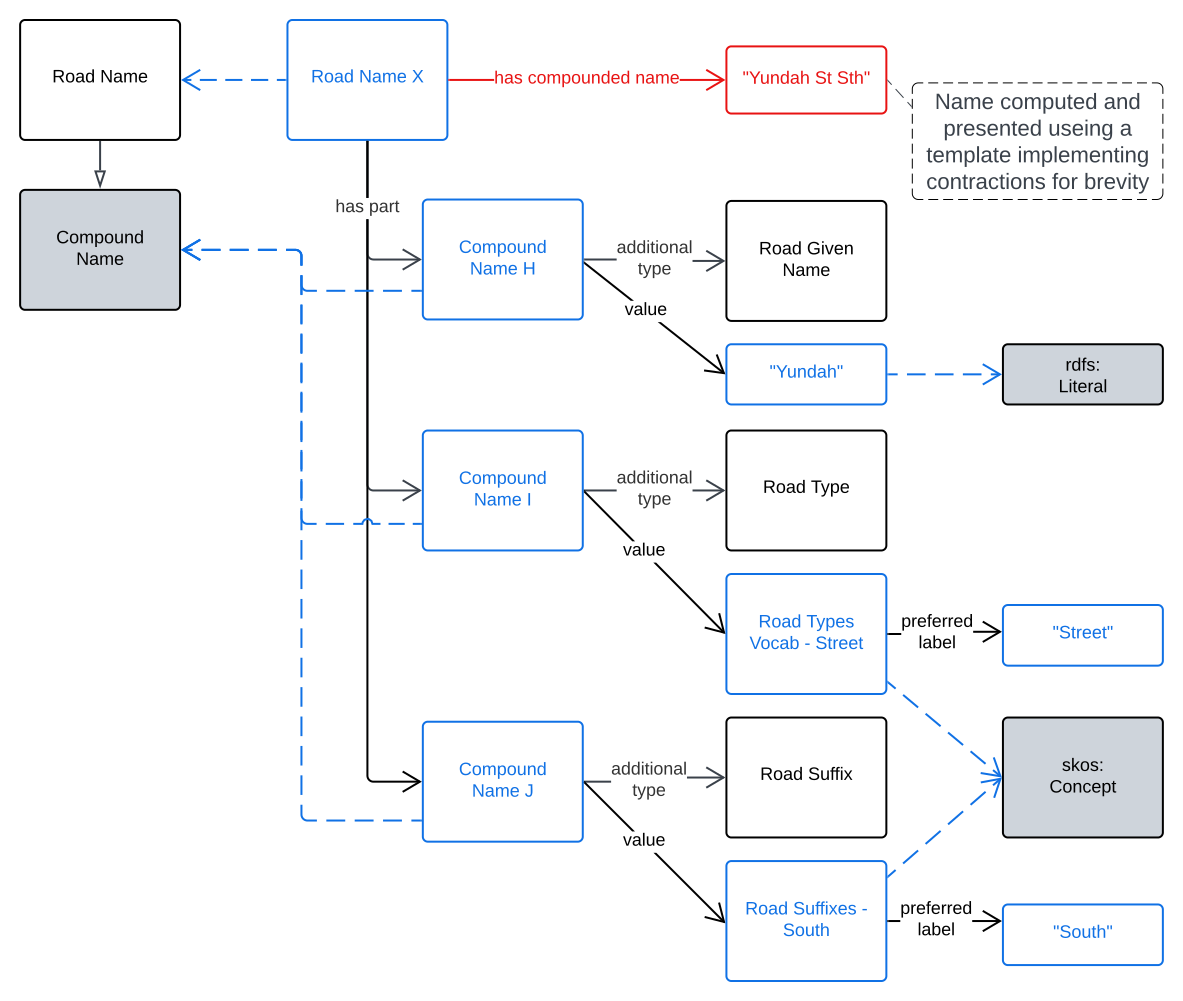
This model contains examples per Class and Property in the Model section as well as for each template within in the Templating section. Additionally, the following drawn examples are provided to illustrate modelling intentions.
9.1. Modelling Scenarios
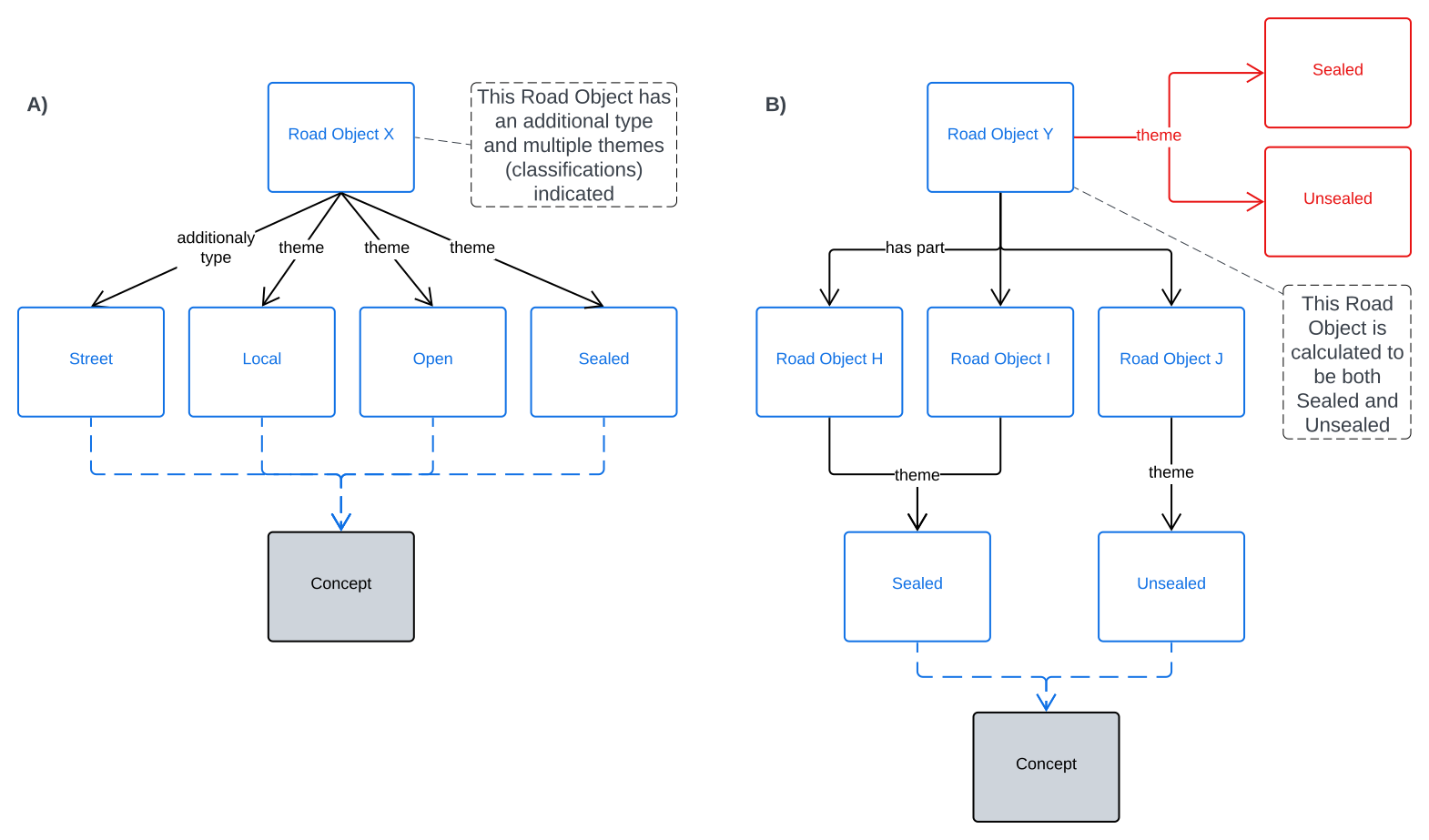
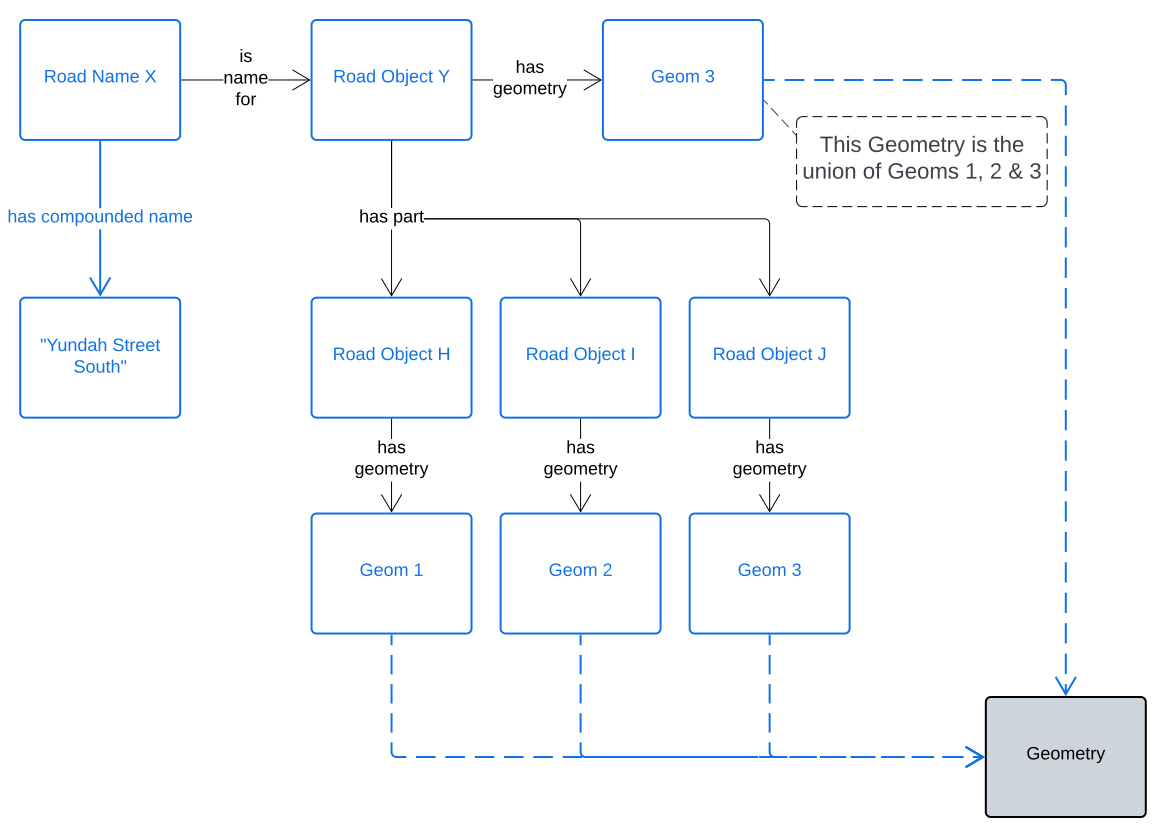
9.2. Code
The following code is the aggregate of the per-Class and Property examples.
# a geospatial Road Object instance
ex:road-x
    a ex:Road ;
.

# Yundah Street South with Feature Name and Lifecycle Stages indicated
ex:road-name-1
  a roads:RoadName ;
  cn:isNameFor ex:road-x ;
  sdo:hasPart
    [
      rdf:value "Yundah" ;
      sdo:additionalType rct:RoadName ;
    ] ,
    [
      rdf:value st:Street ;
      sdo:additionalType rct:RoadType ;
    ] ,
    [
      rdf:value "South" ;
      sdo:additionalType rct:RoadSuffix ;
    ] ;
  roads:hasLifeCycleStage [
    # this Stage has ceased
    time:hasTime [
      time:hasBeginning [ time:inXSDDate "1982-02-10"^^xsd:date ] ;
      time:hasEnd [ time:inXSDDate "1982-05-11"^^xsd:date ] ;
    ] ;
    dcterms:type ls:proposed ;
  ] ,
  [
    # this Stage is still in effect - no hasEnd given
    time:hasTime [
      time:hasBeginning [ time:inXSDDate "1982-05-11"^^xsd:date ] ;
    ] ;
    dcterms:type ls:current ;
  ] ;
.
The example above prints out as "Yundah Street South" using the Basic Template provided in the Templating section and "Yundah St Sth" using that section’s Short Form Template.
Bibliography
- CNM
-
Australian Government Linked Data Working Group. Compound Naming Model. Semantic Web data model (2023). https://linked.data.gov.au/def/cn
- CONNEGP
-
World Wide Web Consortium, Content Negotiation by Profile, W3C Working Draft (20 March 2022). https://w3c.github.io/dx-connegp/connegp/
- DCAT
-
World Wide Web Consortium, Data Catalog Vocabulary (DCAT) - Version 2, W3C Recommendation 04 February 2020, https://www.w3.org/TR/vocab-dcat-2/
- GEO
-
Open Geospatial Consortium, OGC GeoSPARQL - A Geographic Query Language for RDF Data, Version 1.1 (2021). OGC Implementation Specification. http://www.opengis.net/doc/IS/geosparql/1.1
- ISO-IEC-14977
-
International Organization for Standardization, ISO/IEC 14977 : 1996(E): Extended Backus–Naur form. International Organization for Standardization (1996). https://www.cl.cam.ac.uk/~mgk25/iso-14977.pdf
- ISO19101-1
-
International Organization for Standardization, ISO 19101-1:2014 Geographic information — Reference model — Part 1: Fundamentals (2014)
- ISO19156
-
International Organization for Standardization, ISO 19156: Geographic information — Observations and measurements (2011)
- ISO19160-1
-
International Organization for Standardization, ISO 19160-1: Addressing Part 1: Conceptual model (2015). https://www.iso.org/standard/61710.html
- LM
-
Australian Government Linked Data Working Group. _Lifecycle Model (2023). https://linked.data.gov.au/def/lifecycle
- OWL
-
World Wide Web Consortium, OWL 2 Web Ontology Language Document Overview (Second Edition), W3C Recommendation (11 December 2012). https://www.w3.org/TR/owl2-overview/
- PROF
-
World Wide Web Consortium, The Profiles Vocabulary, W3C Working Group Note (18 December 2019). https://www.w3.org/TR/dx-prof/
- PROV
-
World Wide Web Consortium, The Profiles Vocabulary, W3C Working Group Note (18 December 2019). https://www.w3.org/TR/dx-prof/
- RDF
-
World Wide Web Consortium, RDF 1.1 Concepts and Abstract Syntax, W3C Recommendation (25 February 2014). https://www.w3.org/TR/rdf11-concepts/
- RDFS
-
World Wide Web Consortium, RDF 1.2 Schema, W3C First Public Working Draft (16 May 2023). https://www.w3.org/TR/rdf12-schema/
- SDO
-
W3C Schema.org Community Group, schema.org. Community ontology (2015). https://schema.org
- SSN
-
World Wide Web Consortium, Semantic Sensor Network Ontology, W3C Recommendation (19 October 2017). https://www.w3.org/TR/vocab-ssn/
- SKOS
-
World Wide Web Consortium, SKOS Simple Knowledge Organization System Reference, W3C Recommendation (18 August 2009). https://www.w3.org/TR/skos-reference/
- TTL
-
World Wide Web Consortium, RDF 1.1 Turtle Terse RDF Triple Language, W3C Recommendation (25 February 2014). https://www.w3.org/TR/turtle/